





























Uncontrolled frenzy around the tulip, tulipomania is considered the first speculative bubble in history. This enthusiasm for a small, familiar bulb, now affordable for everyone, seems unimaginable! Yet, before becoming the most popular flower in its category, the tulip indeed travelled and became a coveted item exchanged for a fortune.
So why this tulip crisis? What legacy have tulips left us? Let’s travel back a few centuries to trace the tulip and its incredible journey in Europe…
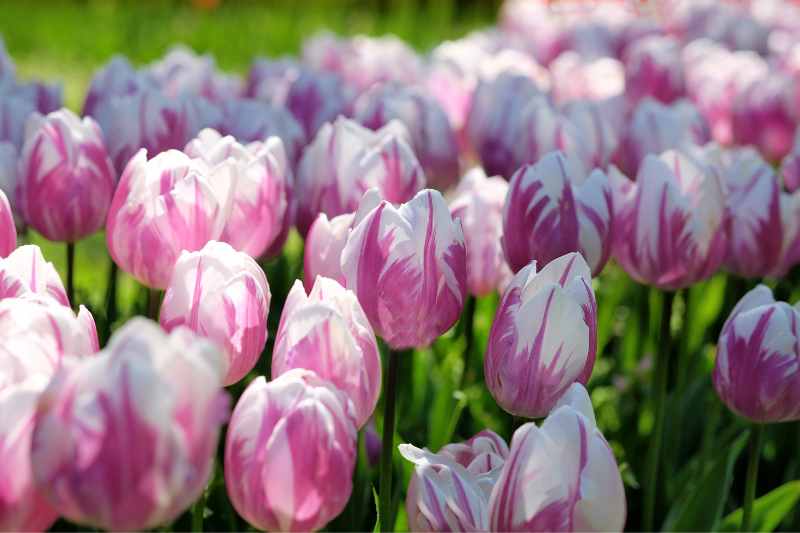
What is tulipomania?
Much has been said and written about tulipomania, that moment in European history when tulips were sold for exorbitant prices on the market. A troubled period, a fascinating and worrying phenomenon… It all unfolds in the 17th century, during the Dutch Golden Age, which radiates across the world, the seas, and trade.
Introduced around 1560 in the United Provinces (now the Netherlands), tulips first sparked the interest of botanists, and soon that of the general public. They garnered admiration in the Netherlands, but also in France, where they were planted in the gardens of the Louvre, with Louis XIII making them a symbol of luxury, and Louis XIV adopting this flower as the official flower of the court…
It was Charles de l’Ecluse (Carolus Clusius), a botanist and professor at the University of Leiden, who began planting the bulb in the sandy soils of the university garden in 1594, thus reproducing the tulip.
Horticulture was already developing in the province of Holland, where around fifty varieties were known by 1580. But by 1630, everything accelerated: over 100 different species of tulips arrived in less than a century.
The tulip became synonymous with success, an outward sign of wealth, and the powerful elite of the country understood this well. One must have them in their garden. Flemish bourgeois, nobles, and tavern owners began cultivating tulips, with some even abandoning their flourishing businesses and shops…
It became so coveted that sales now took place on a secondary market. The tulip became an object of speculation. A financial system was even established around what were called effect notes: from 1635 onwards, this mechanism allowed bulbs to be sold year-round, even while still in the ground, whereas previously tulips were sold in spring when one could assess the flower's conformity. A simple paper was signed, a sort of tulip share, where the merchandise was no longer visible... This sparked unparalleled enthusiasm, exchanging titles multiple times a day to drive prices up.
Tulips were exchanged for astronomical prices, or for land, livestock, silver cups, tons of grain, and other absurdities. It was said that the price of a beautiful bourgeois house on the Dutch canals could buy a single tulip or that it cost ten to twenty times the annual salary of a skilled artisan to procure the precious bulb at the height of the crisis. Even in France, tulipomania raged, as in Lille, where a tulip bulb became the currency of exchange for a brewery, which would bear the name of the tulip brewery. Between 1633 and 1637, tulips were the subject of frenzied trading, with gardens even being raided to unearth the precious bulb. The 'Viceroy' tulips streaked with lilac, and ‘Semper Augustus’, rare with marbled white petals (actually afflicted by a virus, difficult to reproduce), reached records, equivalent to 110,000 euros for a single bulb today. The bursting of the first speculative bubble in history was not far off…
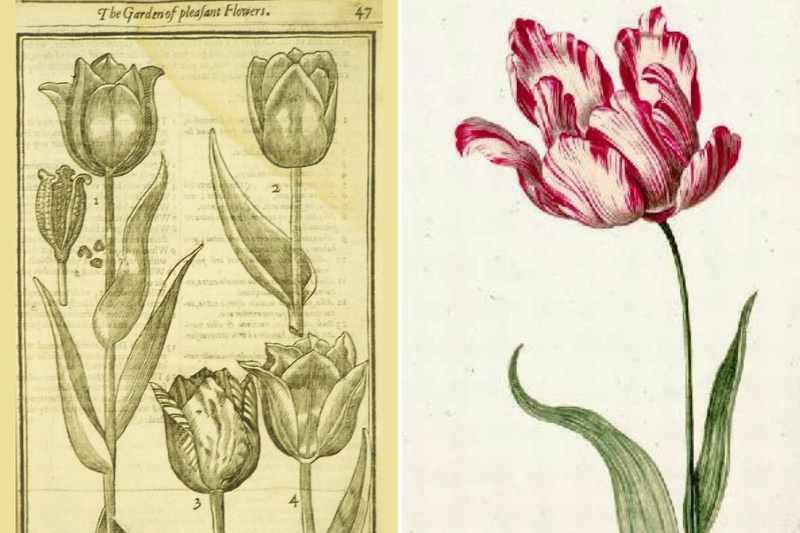
In February 1637, after two years of uncontrolled growth, tulips suddenly found no buyers in Haarlem, and sold poorly, even causing a discount… unprecedented! The government had to intervene to regulate sales. Prices collapsed, word of mouth did the rest, leading to a dizzying drop in market prices.
All those who had bet on the tulip found themselves ruined overnight, while large fortunes, empires built around the tulip, had emerged a few years earlier. The enthusiasm for tulips fell almost overnight. However, the real impact on the economy of the United Provinces was not as severe as that, as the merchants involved remained a restricted elite of the country. In contrast, a moral crisis emerged, denouncing, often in the arts, the indecent profits of a part of society, as seen in Jan Brueghel the Younger's painting satirising the tulip in 1640, where he caricatures speculators as monkeys. Later, other painters would also take up this subject, such as Jean-Léon Gérôme and The Duel at the Tulip (1882), followed by various authors. This was also followed by a number of works on tulip cultivation, including the famous Treatise on Tulips in 1765.
The fascination for tulips continued to be felt until the 19th century, with the famous novel The Black Tulip by Alexandre Dumas (father) which takes us back to the previous 17th century in Holland, where the main character dreams of creating a black tulip to win a fabulous reward.

Turkey: the other land of tulips
But let’s go back even further in time to find the origins of this small bulb… and the first fans of tulips!
Tulips actually come from the East, where they grew wild in the steppes of Central Asia, between Iran, the Caspian Sea, and as far as Afghanistan. These are botanical species of very small size, in warm colours, from yellow to red. They were known and cultivated as early as the 11th century in these regions. They gradually made their way to Anatolia, first through caravans returning from the Silk Road. Then Suleiman the Magnificent conquered some of these regions in the mid-16th century, and nomadic tribes brought back these beautiful flowers in large numbers, landing in Constantinople, now Istanbul. The tulip then became the flower of the sultans.
During the reign of Suleiman the Magnificent, the tulip was everywhere: in the sumptuous gardens of the Ottoman palaces, but also on the ceremonial caftans of the sultans, fabrics, and on the Iznik ceramics, this city that would make ceramic art shine throughout the country. Tulips were a recurring motif, along with the carnation, in the ceramics of the Topkapi Palace, as well as in mosques where floral representation was common. Tulips also adorned the sultan's turbans: Suleiman was known to stick one in his. Fashion did the rest… It was indeed the Turks who first became enamoured with this small, colourful bulb! In Ottoman art, the tulip symbolised the divine.

The word tulip comes from the Persian word, tülbend, which became türban in Turkish: originally a traditional turban of the Turks, they had taken to adorning their headgear when the tulip was introduced to the country. By confusion, the name tulipan was soon attributed to the flower. The Latin name tulipa became widespread in Europe from 1593. However, in Turkey, the flower still retains its original name of lale.
It is reported that in 1554, Suleiman the Magnificent offered some bulbs to a Flemish diplomat, the ambassador of Austria in Constantinople, Ogier Ghislain de Busbecq. He is credited with introducing the tulip to Europe, as he met Charles de l'Ecluse in Vienna a few years later, to whom he handed over some bulbs. Clusius would soon leave to work in Leiden, in the Netherlands, and successfully attempt to multiply tulips there... The rest is tulipomania and its excesses...
In Istanbul, since 2005, every April, the Tulip Festival takes place, a vibrant spectacle, a true open-air exhibition, celebrating the arrival of spring by honouring the tulip in many parks across the city. This is the direct legacy of the tulip festival that took place during the time of the sultans, up to Ahmed III, in the early 18th century, the peak of tulipomania in Turkey, more commonly known by historians as the "Tulip Era".
Tulips today around the world
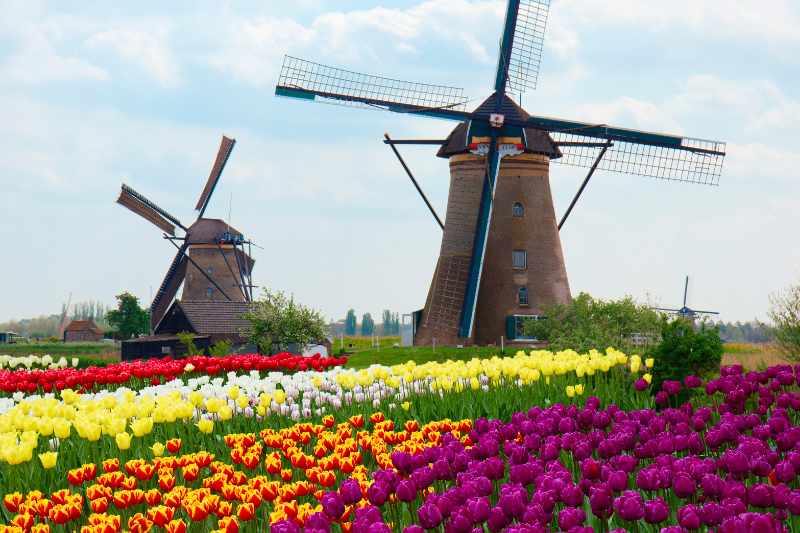
Since tulipomania… not much has changed in tulip production, as today, they are still primarily produced in the Netherlands, which is the world's leading producer. The tulip has become the emblematic flower of the country. Holland even has a world-renowned showcase at Keukenhof, where millions of tourists flock each year to admire the mass-planted flowerbeds. Over twenty thousand hectares are dedicated to bulb flowers in Holland, half of which is solely for tulips, still in the same region of Lisse, the cradle of production in the Netherlands, between Leiden and Haarlem.
Today, there are over 150 different varieties of tulips, and thousands of hybrids. Some producers continue to uphold a French tradition by producing and developing bulb plants, including tulips, particularly in Anjou where the sandy and loamy soil along the Loire is conducive to their cultivation, or in the Landes region.
At Promesse de fleurs, one in three spring bulbs sold is a tulip... There is no doubt that this wonderful little bulb - now affordable - has a bright future ahead!
Further reading
- Everything you need to know about the history of the tulip, with a reference book: The Tulip by Anna Pavord, (2001). Ed. Actes Sud;
- Read or reread The Black Tulip by Alexandre Dumas, a classic;
- Browse online at the BNF, the book by Charles Malo, History of Tulips (1821);
- Explore The ABC of Tulips, by Yves-Marie Allain and Catherine Garnier. 1996. Ed. Flammarion;
- Visit the Keukenhof park near Amsterdam where 7 million bulbs are planted each year, and explore the Amsterdam Tulip Museum.
- Bulbs 2026: 7 spring novelties to plant now!
Uncontrolled frenzy around the tulip, tulipomania is considered the first speculative bubble in history. This enthusiasm for a small, familiar bulb, now affordable for everyone, seems unimaginable! Yet, before becoming the most popular flower in its category, the tulip indeed travelled and became a coveted item exchanged for a fortune. So why this tulip crisis? […]
Tulips are, among the spring flowering bulbs, the easiest to succeed with: well-sized, standardized bulbs that are almost always homogeneous in quality; they are the easy bulbs par excellence; and yet, it is just as easy, with a little attention, to fail at planting them.
Follow our meticulously established guide, based on the author's extensive first-hand experience with various failures, and also, let’s thank them in passing, the help of many inventive clients who, by phone or email, have vigorously explained their little secrets leading to failure.
Lesson number 1: to fail with your tulips, plant them in late spring or summer
Living in Flanders, I regularly spend weekends (cultural) in Amsterdam, and I have always been amazed to see, in May-June, a plethora of tulip bulbs for sale at the Amsterdam flower market… For a long time, I wondered what that could yield. So I eventually tried planting Dutch tulips in late spring, among other local crops.
The result was quite pitiful: a third of the bulbs did not start, the rest bloomed roughly at the same time as my dahlias, and most of my bulbs did not survive the following winter.
Grandma and popular wisdom say: "tulips should be planted in autumn, preferably in September or October."

Tulips should be planted in autumn!
Series of tests conducted at the nursery nuance this result: tulip bulbs establish better if planted in autumn; results are respectable for winter planting, but become frankly random from March-April onwards.
So, to fail with your tulips, plant them whenever you think of it, in April-May when they are blooming at your neighbour's and it makes you green with envy. The result will be, at best, mediocre.
Proposed variant for distracted and lazy gardeners: buy them in autumn, forget them in the garage for a year and plant them the following autumn, guaranteed failure at 95%! We often advise clients who call us in January after finding a packet of bulbs wickedly hidden by the cleaner at the back of the shed to plant immediately: flowering will be slightly delayed, but quite acceptable.
Lesson number 2: to fail with your tulips, sort your bulbs very ri-gou-rous-ly (and throw them all away)… or don’t sort them at all!
While the first lesson was suited to lazy, procrastinating Latin gardeners like me, the second is aimed at neat freaks, preferably with a background from across the Rhine.
Cultivated tulip bulbs are mechanically harvested by machines with sorts of harrows. It’s not extraordinarily poetic, but effective (and it’s what allows you not to pay ten euros per bulb).

Mechanical harvesting of tulip bulbs
In the process, many bulbs lose their little protective copper-coloured skin (of no importance), and some end up slightly scraped, sometimes superficially nicked, without any detrimental consequence on the bulb's recovery.
On the other hand, mould is a very serious enemy of the tulip bulb: during autumn, bulbs, especially if stored in humid conditions, tend to develop a layer of mould. If this damage is superficial, a quick wipe will remove it, and recovery will be perfect. However, if this mould reaches the inside of the bulb (signal: the mould doesn’t come off with a quick wipe), particularly at the root plate, the bulb has no chance of recovery. Worse: the mould may spread to other nearby tulip bulbs. This is why we manually sort all our tulip bulbs during packaging; also the reason why it is advised to plant tulips in September or October: bulbs are, at that time, practically free from mould attacks.
So, to fail with your tulips, throw away all the bulbs for non-compliance before planting… Or conversely, leave a packet of bulbs lying around in a humid place, and, with a bit of luck, the bulbs will mould within a few weeks.
Lesson number 3: to fail with your tulips, plant them in an unsuitable place: deep shade, marsh, extremely heavy soil, or rocky areas where nothing grows
The tulip, true to its Ottoman origins, loves sun and fairly well-drained soils, which do not retain too much water, but are relatively rich, to allow the bulb to replenish its reserves after flowering.
It blooms on the reserves accumulated by the bulb, even if the growing conditions are poor, so it is difficult to fail the first year. However, if the conditions are sufficiently bad, the bulb will not be able to properly replenish its reserves after flowering: thus, by the second year, the flowers will be weak or absent.
If the bulb is planted in complete shade (less than two hours of sun per day), the flowers will be weak.
If the bulb is planted in very heavy and wet soil, some bulbs may rot from the first year, the rest in subsequent years.
If the tulip is planted in excessively dry soil in spring, the tulips will be stunted, with early yellowing of the foliage, and will not return.
Note: there’s no need to try to fail your tulips by planting them in very acidic or calcareous soil: tulip bulbs tolerate all pH levels, you will not fail them with this classic method.
For technical enthusiasts, it is interesting to note that not all tulips have the same resistance to difficult conditions.
The botanical tulips (small tulips that maintain a distant relationship with their natural ancestors) are ultra-tough. They last for many years even in shaded heavy soil. They naturalise as soon as conditions are suitable. Very difficult to fail, a challenge!
The old horticultural tulips (e.g.: Lily-flowering, Triumph) are quite sturdy. They last about 3 years in poor growing conditions, 7 to 10 years in good growing conditions. Difficult to fail.
The double tulips (peony-flowered tulips) are generally fragile, lasting 2 to 5 years depending on growing conditions. Quite easy to fail.
In summary, to fail your tulip plantings:
- If you live in the northern half of France: plant recent double-flowered varieties in heavy, wet soil in a very shaded position. And if the winter is dry, water abundantly to ensure failure.
- If you live in the south: plant the same varieties in poor, stony soil, without any watering, and cross your fingers for a very dry spring, a guarantee of failure.
Lesson number 4: to fail with your tulips, plant them upside down, or too deep, or not deep enough
Tulips have a top (the small point) and a bottom (the flat area from which the roots will emerge); if planted upside down, point down and roots up, they will struggle to emerge…. To be honest, I must admit, I have never actually tried this method. But I know it works, having dealt with a furious client about the poor quality of our bulbs. He had carefully planted his bulbs upside down…
Variants of failure:
- Maniac version: planting your bulbs too deep (result: stunted tulips… or even no tulips at all). This is a classic method that requires effort; you need to dig deep, about thirty centimetres, but it is worth it: you end up with rather ridiculous-looking tulips.
- Lazy version: planting your bulbs too shallow (bulb almost at the surface), a method that is very economical in time and effort, which is why I like it so much. However, it is more random; sometimes tulips settle in well despite everything, who knows why.
To properly plant your tulips, here’s what a good gardener would write:
- Make a hole 4 times the diameter of the bulb (about 20 cm)
- Fill a quarter of the hole (the height of one bulb) with loose soil, or even potting soil or soil mixed with coarse river sand if you have heavy soil. This effectively extends the number of years of flowering.
- Place the bulb, point up, at the bottom of the hole (about 15 cm)
Cover with soil. If you haven’t made a mistake in these complicated calculations, the bulb should be covered with twice its height of soil (a good 10 cm).
So, to fail with your tulip plantings, plant them upside down, far too deep, at least 20 cm deep, or too shallow, less than 5 cm, in uncompacted soil.
Lesson number 5: how to fail the re-flowering of tulips: early digging or mowing, famine or death by thirst
Nature is poorly made: tulips in the garden need a little attention just when you stop taking care of them, after flowering, when these sublime beauties fade and turn into unsightly stems and leaves that are more or less yellowish.
The post-flowering period, generally April-May or May-June, is when tulip bulbs replenish their reserves to be able to bloom again the following year: they need their foliage, a bit of water (especially if they are planted in pots), and appreciate some fertiliser. You can safely cut the flower stems, but a good gardener does not cut the foliage before it has completely yellowed. On the contrary, they will stimulate it, with a bit of fertiliser, and water in case of spring drought. The said good gardener also plants, in front of or among their tulips, spring-flowering perennials, like brunneras for example, which help to mask the unsightly foliage of tulips after flowering, without having to cut it prematurely.
So, you guessed it, to prevent your tulips from re-flowering properly, you need to thwart this regeneration. The simplest way is to mow immediately after flowering over your tulip bed: the bulbs will not re-flower, or very little. And if you repeat the mowing after flowering the second year, you will eliminate the last survivors.
Note: it was traditional among old gardeners to dig up tulip bulbs at the end of spring to replant them in early autumn. This custom has fallen out of favour, as it does not significantly improve their lifespan. In theory, digging and storing in trays reduces the risk of fungal disease (like fusarium); in practice, there is generally more risk related to poor storage conditions (excessive humidity, presence of rodents, etc.) than to leaving them in the ground in a properly drained garden. In short: leaving your bulbs in the ground will not significantly increase your chances of failing them.
In summary, to prevent tulips from re-flowering in the second year, mow your beds immediately after planting.
* * *
As a special bonus to reward readers who have had the patience to skim through all these many lines:
Bonus gift: how to create an ugly tulip bed?
You can succeed in growing tulips, and still easily end up with a very ugly result. It’s very easy; here are some little tricks from a specialist to help you:
- Mix a lot of non-complementary colours
It is often said that a beautiful bed plays on two colours, a maximum of 3. If you mix bulbs of 4 or 5 non-complementary colours, you will generally achieve a garish result that will remind you of your grandmother's plant mail-order catalogues (no, we won’t name names!).
- Plant several varieties side by side without mixing them
You randomly acquire the magnificent collection of tulips "Carnival of Venice" from Promesse de fleurs (our best seller for 30 years), and instead of mixing the 5 matching varieties of this collection for a harmonious result, plant each variety separately. Even better: instead of planting naturally, that is to say, a bit irregularly, make nice straight planting lines, just like in the vegetable garden. The result will be… strange!
- Plant insufficiently dense
Experienced gardeners plant tulips quite densely for a nice group effect. Without necessarily planting in large numbers, a nice effect can be achieved with 10 bulbs planted in a "potato" shape over 20 cm2, or even with 5 bulbs grouped in "clumps" in the same large planting hole, with a spacing of about ten cm between bulbs.
You read on promessedefleurs.com that you can plant a hundred tulip bulbs per m2, at least 50, and your mother-in-law boasts with her beds of 150 tulips per m2. But since you’re not easily fooled, and you know the generally dishonest mercantile spirit of Promesse de fleurs and your mother-in-law's reckless spending when it comes to anything other than your birthday gift, you scoff and plant your bulbs economically, 10 bulbs per m2; it sounds good, and it makes… one bulb every 40 cm.
Bravo!
The result will be bizarrely ugly: you will have the vision of a small forest of stems (tulip stems are always unsightly). And if you combine this with the previous advice, I promise you that neighbours and passers-by will stop in front of your garden to contemplate your bed.
I promise you this, as I still vividly remember, despite the time that has passed, a sort of gathering of giggling neighbours one day in front of the magnificent first flowering of my very first tulip bed.

Tulips are, among the spring flowering bulbs, the easiest to succeed with: well-sized, standardized bulbs that are almost always homogeneous in quality; they are the easy bulbs par excellence; and yet, it is just as easy, with a little attention, to fail at planting them. Follow our meticulously established guide, based on the author’s extensive […]
A light mist enveloped the garden this morning... After a surprise heatwave, is autumn already showing its first signs? Anyway, I won't talk about the weather, but about a topic just as vast: tulips! It's the start of the bulb planting season, and the question arises: which tulip to choose from the hundreds of varieties offered in catalogues?
Of course, there’s personal taste to consider, and with 3000 varieties registered and new additions each year, it can be said that when it comes to tulip bulbs, there’s something for everyone! To help you navigate, successive generations of horticulturists have grouped the various varieties into groups or families of tulips, each responding to specific botanical and aesthetic criteria (more or less) precise, as well as usage: depending on the flowering period, your soil, or the style of your garden, you will turn to specific families in which you will seek the most beautiful to your eyes... Discover some tips and landmarks.
1) Choosing tulips according to flowering time
The tulip is one of the most beautiful and famous of the spring-flowering bulbs. Its colours, often vivid and sometimes subtle, brighten the first days of fine weather or, conversely, awaken the sometimes still grey days of early spring. Fortunately, the horticultural classification of tulips also corresponds to the flowering calendar! It is therefore very easy to navigate, and by combining varieties from several families, you can achieve up to 2 months of continuous flowering... what more could you ask for? Of course, the chronological markers on flowering dates provided are not "an exact science" and should be nuanced by the climatic variations observed regionally and from year to year.
In bloom from March-April, the early tulips
- As their name suggests, early single tulips and early double tulips, including the famous hybrids 'Murillo', are among the first to bloom, from early April. They rarely exceed 35cm in height and are thus sturdy enough to withstand bad weather.
- They are, however, preceded by certain botanical species and their hybrids. Among the botanical tulips, there are wild species, although they have unfortunately often disappeared from their natural habitat, with a flowering period that is not uniform and extends from March to June depending on the species. From early to mid-March, you can count on Tulipa tarda, Tulipa humilis and its many varieties, Tulipa clusiana, Tulipa turkestanica... and many others that are rarer! These rarely exceed 10 to 15cm in height.
- The botanical tulips from the greigii group, with marbled black foliage, kaufmanianna or "water lily tulips", and the excellent fosteriana ('Purissima', 'Madame Lefeber', 'Orange Emperor'...) have vivid and varied colours, measuring 20 to 30cm in height, 40cm for fosteriana, they bloom from late March to early April and thus precede the "early" tulips by a little.
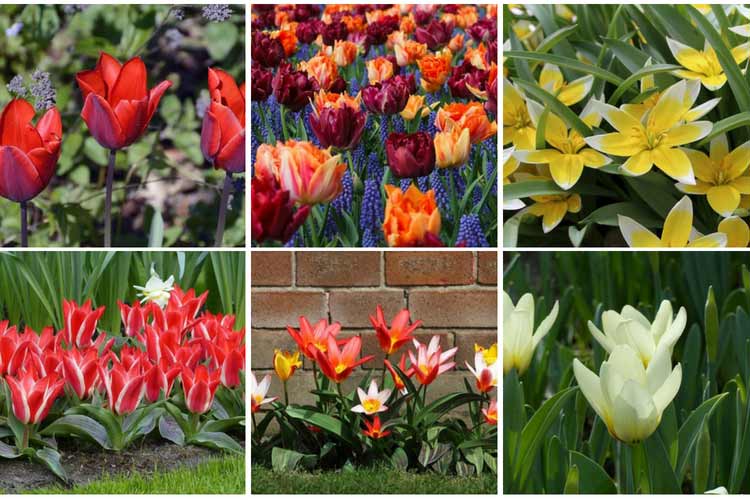 Early single tulip 'Couleur Cardinal' - Early double tulips 'David Teniers' and 'Willem van Oranje' (Murillo) - Tulipa tarda - Greigii tulip 'Plaisir' - Kaufmanniana tulips - Fosteriana tulip 'Concerto'[/caption>
April flowering, the heart of the tulip season
- The Triumph tulip, aptly named, was obtained by crossing an early single tulip and a late tulip, and blooms just in time in April. Triumph tulips now form one of the largest and most diverse groups. 'Attila', 'Princess Irene', 'Shirley', 'Gavota', 'Negrita'... are among the best-known and most appreciated. With an average height of between 40 and 50cm, varieties from this group offer great possibilities for use, in beds as well as in pots and as cut flowers.
- To obtain even more choices in tulips blooming in April, it is also possible to "pick" from the neighbouring groups of parrot tulips and lily-flowered tulips, whose varieties share only their shape. Some are indeed derived from natural mutations of 'Triumph' tulips and have thus changed shape while retaining the same flowering time, such as 'Princess Irene Parrot' for example. 'Ballerina', with orange lily-shaped flowers and a fragrance, also always blooms in the second half of April in my garden.
- The tallest of the "botanical tulips", those measuring about 30cm high, are also in bloom in April: Tulipa praestans, Tulipa whittallii, and the rare and beautiful Tulipa orphanidea 'Flava', to name just a few.
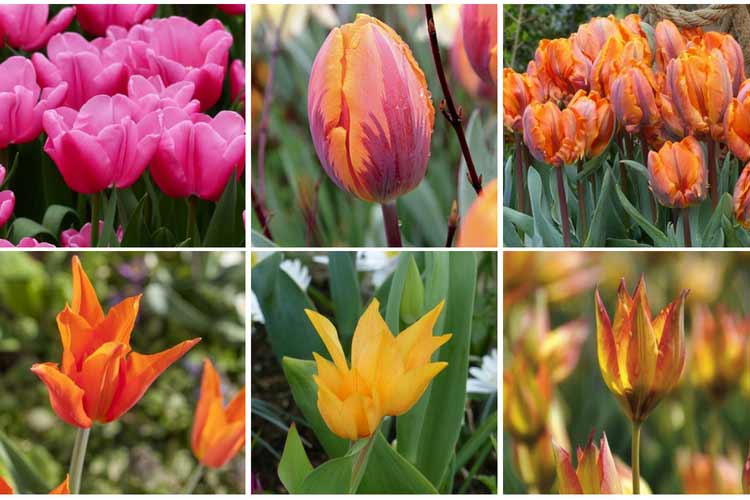 Triumph tulip 'In Love' - Triumph tulip 'Princess Irene' - Parrot tulip 'Irene Parrot' - Lily-flowered tulip 'Ballerina' - Tulip praestans 'Shogun' - Tulipa orphanidea 'Flava'[/caption>
In bloom from late April to mid-May, the late tulips
- The "Darwin" tulips, with large flowers appearing in late April on strong stems that are 50 to 60cm long, are excellent reliable and sturdy garden varieties, always spectacular, but not always to everyone's taste with their pure and contrasting colours ranging from yellow to red, highlighted by a large black heart at the base of the petals ('Apeldoorn', 'Golden Apeldoorn'...).
- The late single tulips, also called "cottage" or "long-stemmed" tulips, reaching 60cm in height or more, and their counterparts, the late double tulips or "peony-flowered" like 'Angélique', bloom in early May. They are the undisputed queens of bouquets! Many varieties are indeed French creations developed for the production of very high-quality cut flowers in the South: 'Avignon', 'Dordogne', 'Ollioules', and of course 'Roi du Midi' are among them.
- The "original" tulips: frilly parrot tulips, elegant lily-flowered tulips, delicate lace or fringed tulips, and fascinating viridiflora tulips like 'Groenland' or 'Spring Green' with flowers striped with a central green band, should be planted in well-maintained beds as these horticultural creations are not always the most resilient.
- Tulipa sprengeri: the exception that confirms the rule, this highly sought-after botanical tulip is always the last to bloom, in June! Its red-orange flowers with slightly pointed petals are both unexpected, elegant, and spectacular. Very rare, it naturalises easily in the sun, provided it is never disturbed by soil work.
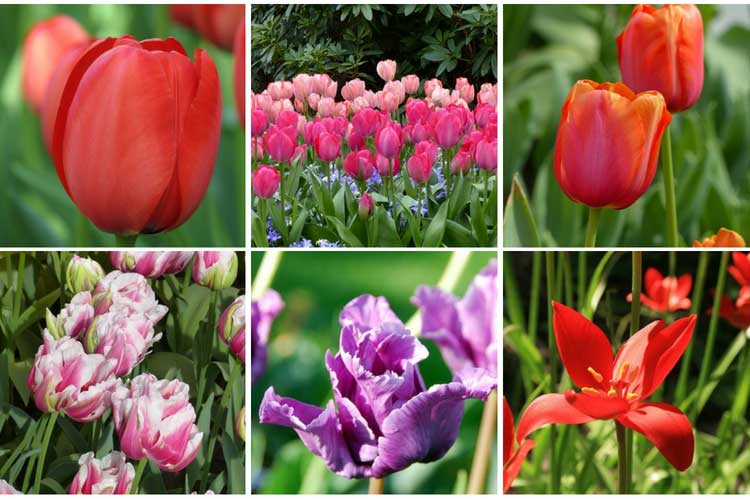 Darwin tulip 'Apeldoorn' - Darwin tulips 'Van Eijk' - Late single tulip 'Avignon' - Late double tulip 'Fantasy Lady' - Parrot tulip 'Blue Parrot' - Tulipa sprengeri[/caption>
2) Choosing tulips according to your soil type
While they thrive in all soils, tulips prefer rich, loose, well-drained soils, warm in summer, without stagnant moisture in winter, with a neutral to alkaline pH (calcareous).
- In a "good garden soil", black and rich, loamy or clay-loamy, as long as there is drainage, all fantasies are allowed, choose at your leisure! You can even leave the bulbs in the ground over winter, without any qualms, except for the most fanciful varieties, your tulip bulbs will return more numerous year after year. If this is the case in your garden, go directly to point 3!
- In heavy clay soil, "sticky" and clinging to fingers and tools... it’s a different story! You can only grow tulips in beds with enriched and amended soil with compost and sand, well worked each year, and on the condition of lifting the bulbs at the end of flowering before drying them for replanting the following autumn. Even doing this, some varieties exhaust themselves faster than others, and you will need to buy new bulbs more often. Of course, you can always circumvent the problem by planting the most precious varieties in pots!
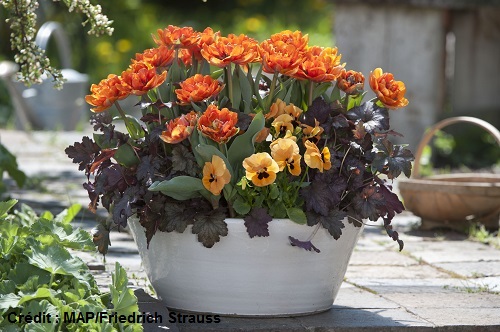 If you have very heavy clay soil, waterlogged in winter, prefer tulips in pots!
- In dry and light soil, sandy, poor, or if your soil is calcareous and shallow, as well as in rockeries, turn to botanical tulips. They take up little space, naturalise, and do not degenerate. Due to their wide range of origin, there is always a species whose growing conditions in nature will be close to those of your garden.
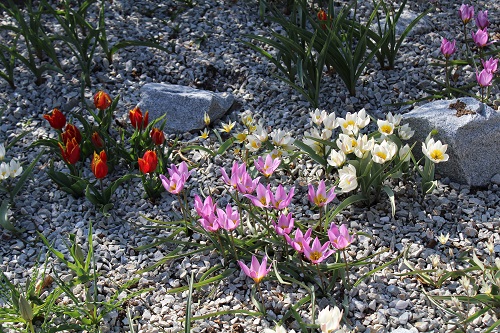 In dry and light soil, poor in nutrients, or in rockeries, small botanical tulips will be your best allies!
3) Choosing tulips according to your garden style
Obvious, you might say? Once you’ve passed the filters of flowering time and soil, you still have to pass a subjective filter, that of your style and your tastes! Classic or contemporary, natural, mineral, small, large, English, French... there's a tulip for almost every garden style, except perhaps the traditional Japanese garden! Not to mention that their possibilities for association are exponential....
- In a contemporary style garden, opt for tulips with well-defined shapes, clean and elegant lines, such as lily-flowered tulips like 'White Triumphator', simple varieties with perfect shapes like 'Maureen', and viridiflora like 'Spring Green'. Add contrast with the black of 'Reine de la Nuit' or 'Fontainebleau' and even 'Dream Touch' for a classic black and white combination. It’s often overlooked, but botanical tulips can also fit well in this style of garden: look towards Tulipa polychroma or Tulipa whittallii whose shapes remind me of some great works of contemporary architecture...
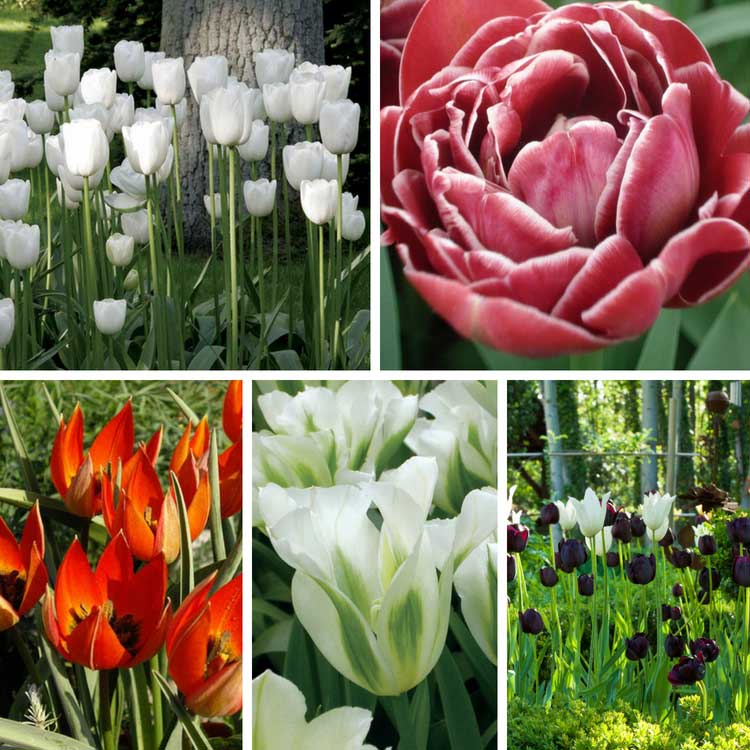 Tulip 'Maureen' - Tulip 'Dream Touch' - Tulipa whittallii - Viridiflora tulip 'Spring Green' - Contrasting tulips: 'White Triumphator' and 'Reine de la Nuit'
- In a romantic style garden, the frills of double flowers, triples, quadruples! The charm of soft colours, pink, mauve, lilac, spotted, the lace of fringed tulips... By combining early and late varieties, it’s easy to have double tulips in bloom for weeks. The eternal 'Angélique' and the precious 'Diamant Bleu' are must-haves to accompany the lesser-known 'Daytona' and 'Huis ten Bosch' in lace, 'Silver Parrot', 'Burgundy'... in a setting of forget-me-nots and fragrant lilacs!
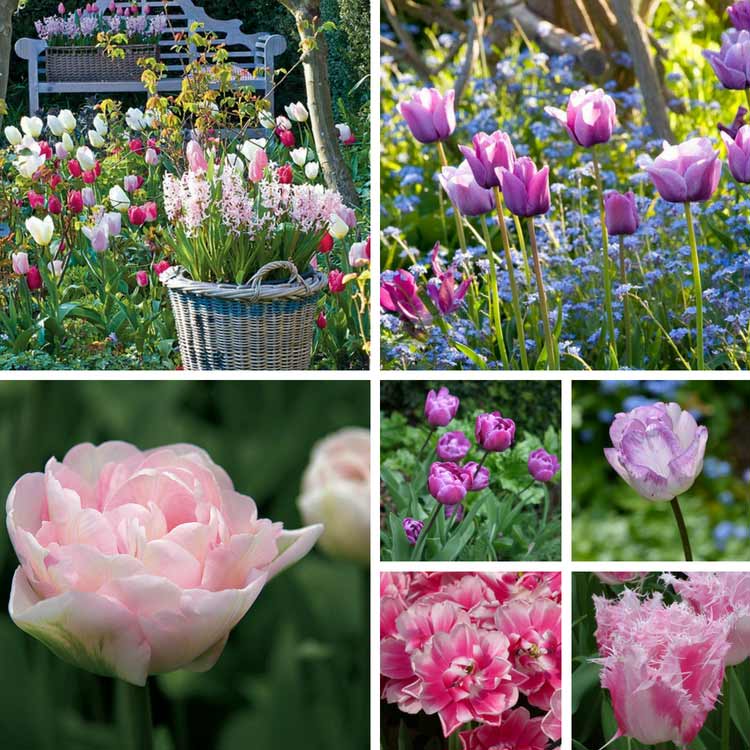 Tulips 'Jazz', 'Synada Amor', 'Page Polka', 'Christmas Dream' and 'Flaming Purissima' create a romantic atmosphere with pink hyacinths - Tulips and Myosotis - Double tulip 'Angélique' - Tulip 'Diamant Bleu' - Triumph tulip 'Shirley' - Early double tulip 'Columbus' - Fringed tulip 'Huis ten Bosch'
- In a natural or naturalistic garden, who said that only perennials and grasses should have a place? The lightness of botanical tulips like Tulipa turkestanica, Tulipa bakeri 'Lilac Wonder', Tulipa clusiana will naturally impose themselves, if I may say so! However, more classic and even almost sophisticated tulips, if well used, planted at controlled densities, will blend in with the brilliance of the greatest virtuosos! For yes, alongside the rose, the tulip is indeed one of the most virtuosic genera we can cultivate in our gardens...
 Planted sparsely, these 'Reine de la Nuit' tulips respect a natural effect alongside wood hyacinths - Fosteriana tulips 'Purissima' with Muscari latifolium - Tulip 'Burgundy' - Tulipa bakeri 'Lilac Wonder' - Tulipa polychroma - Tulipa clusiana 'Peppermint Stick' - Tulipa turkestanica
A light mist enveloped the garden this morning… After a surprise heatwave, is autumn already showing its first signs? Anyway, I won’t talk about the weather, but about a topic just as vast: tulips! It’s the start of the bulb planting season, and the question arises: which tulip to choose from the hundreds of varieties […]